Showing posts with label designer. Show all posts

Sunday, November 20, 2011

Dolly Tree - Still A Shining Star.

 Firstly - What a delightful name. It just trip's off the tongue, and once heard it is never forgotten. Nor should she be. Perhaps you have never heard of her before, Dolly Tree was one of Hollywood's finest fashion designers. Of English birth and born near Bristol in 1899 she aspired to be an actress but by the 1920's and 1930's she was the darling of London's and Paris' Theatre's with her ingenious stage costume designs. Working for the British film company when she could, she was also involved and allied to the couture house of Jean Peron.

It was upon her designs for Mae West's gowns in her saloon scenes, thus creating for her the quintessential 1890's look for her films that Dolly finally moved to America and began her career with the MGM studio during the 1930's.

It was whilst at these studio's that she created the glamorous costumes for Myrna Loy in The Thin Man and other stars such as Judy Garland, Janette MacDonald, Maureen O'Sullivan and  Jean Harlow, as well as historical costumes for great classic films such as Viva Villa, David Copperfield and A Tale Of Two Cities.

Unfortunately Dolly Tree has through out her career consistently been overshadowed by others often taking her credit. For me it is evident that she brough to Hollywood a certain Parisian chic and simplistic air of quality. Unlike Edith Head, Dolly Tree was rather unasertive in a male dominated working environment and so recieved little of the acclaim that she deserved. She is still rather forgotten, except for her gowns and costumes that roles past us in the reels of film on the silver screen. Look at her beautiful costumes in A Tales Of Two Cities (1935) once again and then see if you ever forget her name.

As well as all the above she also kept her hand in designing beautiful delicate commercial illustrations. From her earliest days she had designed posters and programme covers for theatre shows. This led to comic art and illustrations for newspapers and magazines. She was also jolly good at movie star charicatures and sold many to magazines of the time. Most of her illustration designs involved or featured a young woman with the most gorgeous outfit or costume which she described as "Fluffy Flappers". They were the early beginnings of her truly outstanding expressive and stylised fashion sketches she would produce in later years for the Hollywood studios.
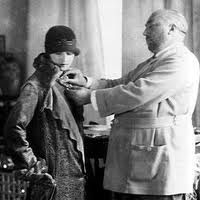
Myrna Loy and Dolly Tree.
Myrna Loy in a Tree dress.
For me it is most certainly the fact that she almost exclusively designed for the actress Myrna Loy, and boy did she look good in them! She did all of Myrna's costumes for The Thin Man productions, for which I am eternally grateful. Her sketches and designs are so beautiful on paper, that it would be almost a sin not to breathe life into them with flesh and fabric.

Dolly Tree was slim, petite with a dark sleek bob cut and large blue eyes, she was the epitome of chic. The producer and designer Alex Shanks once described her as "a chic, bobbed ex flapper, cigarette holder an all".

Dress design for Jean Harlow.
Her genius as a visual designer is her childlike quality and love for all things simplistic, saying "I try to get a mental picture of the whole finished effect and then I arrange my colours, rather like playing with toy soldiers." 
Her designs were always imaginative but with a simple flourish. She disliked a cacophony of colours together preferring a harmonious colour palette. She considered the figure of the woman against the background. The silhouette was just as important as the form, giving rise to her often being known as "the two colour lady". Instead to gave her emphasis to minute unusual detail and has often been credited at the woman who gave us the strapless gown.

"Give me a blank piece of paper, a peaceful hour to think out designs - and I'm perfectly happy" 

In 1931 whilst working at Fox's studio's she met and married a young Naval officer by the name of Thomas Kimes. Although a happy marriage, his career in the Navy kept them apart and they sadly divorced nine years later. After her divorce she drank heavily and this is almost certainly why she left MGM and went back to work for Fox studios at a later date where she married her second husband Don E.Whiteford, but again things didn't work out and they soon divorced. Alone again Dolly dove further into alcoholism. Her divorce and the recent death of her father in 1942 all helped to contribute to the loss of her second studio job. In disgrace she returned to Long Island in New York and died aged 63 in obscurity in 1962. What a terrible shame to see such a glorious shinning star fizzle out and fade away. To me though her costumes will always shine bright up on the silver screen.

Saturday, November 12, 2011

Edith Head - the designer who spoke womanese with ease.

One cannot even think of Hollywood 1930's glamour movies without thinking of the legendary influential Edith Head. Not only did she design for the films but the actresses themselves. There is no one more iconic than she. She was costume designer extordiaire!
An yet somehow whilst dressing the top Hollywood stars and seeing them stripped down before her large mirror in just their bare necessities she still managed to stay humble to the core, graceful in her taste and style and remain in the background, which is exactly where she felt the most comfortable. This was a woman who believed and I quote,
"You can achieve anything in life if you dress for it".
Her career spanned six decades of Hollywood style and she dressed over 1,000 films. Which when you work it out is roughly about 35 films a year. She was prolific in her designs and dedication. This means if you think about it she would have dressed just about every movie star who graced the silver screen. She was a woman who dominated a world ran by men and commanded respect, all this she did in her own quiet yet determined way.


With everyone the world over admiring her taste and good measurements Edith wrote two books in her long career, The Dress Doctor and How to Dress for Success. She was the first and original Trinny and Susannah rolled into one. The Great Auntie to Auntie Gok. Being so intimate with the movie stars gave Head inside knowledge to their real sizes and insecurities, after all she was the one paid to hide them boasting that she was 'magician' , saying,
 "I accentuated the positive and camouflaged the rest".
Head had the talent to spot the best feature in a person and flaunt it, often making them a star in the process. Certainly she made them a pin up and their clothes something to be copied and desired by American and English audiences alike, producing sewing patterns and ready made store pieces.

Quote: "You dress should be tight enough to show you're a woman but loose enough to show you're a lady".

Hired by the studio at Paramont Pictures as a sketch artist she eventually became head designer with her sketches. Edith won eight oscars in her life for her creations on screen, later quoting ,
"There were eight men in my life, they were all named Oscar". That's more than any other woman has in Hollywood has ever won.

Edith Head dressing Sophia Loren.
Born Edith Claire Posener in 1897 California, USA  she was talented enough to gain entry to art college where she met and married Charles Head, a brother of one of her classmates, although the marriage ended in 1936 due to divorce Edith still kept her professional names as Head right up until her death in 1981 when she passed aged 83.
She worked at Paramount Pictures for forty three years before moving to Universal Pictures and evntually Universal.
Edith married studio set designer Wiard Ihnen in 1940, their marriage lasted until his death from prostate cancer in 1979.

Quote: "Good clothes are not a matter of good luck"

Audrey Hepburn dressed by E.Head
for Sabrina.
Edith was well known for her low-key working style and, unlike many of her male contemporaries, she usually worked exculsively with the female stars of the studio. As a result she was a favorite among many of the leading female stars of the 1940s and '50s such as Ginger Rogers, Bette Davis, Barbara Stanwyck, Shirley McLaine, Grace Kelly, Audrey Hepburn, Elizabeth Taylor , Mae West, Karman Miranda, Veronica Lake, Ingrid Bergman, Dorothy Lamour, Rita Heyworth, Sophia Loren and Natalie Wood are but a few. Edith even on occasion 'lent out' by the studio to other studios on the insistent request of their female stars.

From concept to design Edith Head's understanding and sympathy for the female form is clear. She dresses not for the clothes, but for the woman inside the clothes. Seeing the potential that is there and unleashing it with a fanfare., making the most shrinking of violets into a Princess.
When she designed for a woman she designed for the whole woman. Hiding her inner fears and insecurities while pushing her best assests forward. I have yet to see a badly dressed woman by Edith Head. She knew that each woman was an individual and designed accordingly, tailoring everything to her personal needs in the minutest of detail. When she dressed Sophia Loren, long a heroine of mine for her hourglass figure, Edith knew how hard it was to compliment her shape without making it too trashy with the fitting. Edith hid Audrey Hepburn swan's neck and broad shoulders making her appear petite and waif like, all doe eyes and boyish charm.

Grace Kelly 1954's  Rear Window.


and we ALL know this iconic actress, film
and dress!
I have seen this film hundreds of times and everytime I see this LBD dress I cannot help but marvel at how perfect a dress it is for Hepburn. With her broad shoulders this dress has small just the right size medium straps to come inwards, the necklace hides and draws your eye to the centre, but it is the back that does all the work to complete the illusion. It's those cut out's with side to show us her shoulder blades and then the thin line drawing our eyes inwards to the centre of her spinal column. Perfection in classic black, whether it is the dress  that made her doesn't matter, it is the dress she will forever be remebered for. That in a nut shell is what's so phenomenal about Edith Head's work. She makes statement individual pieces that are so iconic it is the dress that makes the image. It's the dress that wears the wearer and not the other way round. Her designs speak so loudly for themselves that Edith Head never needed to take the limelight, she let them speak for her instead.

Friday, November 11, 2011

Exotic Dressed Beauty - Gene Tierney.

Gene Tierney, a woman I gazed at awe in whilst watching her old movies as I grew up. Her grace, beauty, those eyes, her hair, those shoes, her makeup, those dresses, hats, jewels - she was grace personified. It wasn't so much her presence on screen as what she wore on screen that captivated me. Oh those clothes......(whistles loudly)....beautiful.

Laura 1944.

Funnily enough the films that I admire Gene Tierney in don't contain Tyrone Power. She has a most magical presence in the film The Ghost and Mrs Muir, 1947 which was the first film I ever saw her in. It is my favourite Gene Tierney film for her acting and the script. Not one for beautiful dresses or elaborate costumes, it is a film to nourish the soul. Tierney plays a young widow who moves into a lonely old house on a cliff, by the sea called Gull Cottage, which is haunted by a handsome young sea captain called Daniel, and with whom she falls in love. This is the house I desire to build, I love it so. I have watched and cried at this film easily over a thousand times. It touches my soul deeper than I can ever possibly explain.
Having watched her in the films where she starred alongside Tyrone Power, her appeal lessened and she seemed thin and insipid along side his charms, but that may of course be an immense personal preference on my part.........er hem...(coughs).
I didn't warm to her as an actress in any other film until I saw her in Laura, 1944. Where she played alongside Cliffton Webb, he of Mr Belvadere fame. It is a murder mystery as Tierney's character is the victim, and we the audience are asked to unravel the plot through her letters, friends and personal diaries, along with the policeman investigating her death - who soon becomes obsessed with the deceased character.

My favourite red Tierney dress.
Born in 1920, American actress Tierney died in 1991 aged 70 of emphysema. She suffered from mental health issues after the birth of her first born child and was treated with electric Shock therapy, something that she later claimed took large portions of her memory away. Married twice, her first husband whom she married in 1941 and divorced in 1952, was the noted fashion designer Oleg Cassini, who for several years designed exclusively for his movie star wife. He was assistant costume designer to the legendary Edith Head in the 1930's and later in the 1960's became the favourite designer for the classic American first lady Jackie Kennedy, JFK's wife.
Oleg and Tierney had two daughters together. During her first pregnancy in 1943 Tierney contracted Rubella (German measles) from a brief autograph signing of a fan meet and greet at a movie studio held event. Her daughter was born with severe disabilities due to the illness and had to be intitutionalized. All her daughter's medical bills and life long care were paid for by Tierney's good friend billionaire Howard Hughes.

I love this red dress that Tierney wears in this late 1940's photo shoot, no doubt designed and created by her loving husband Oleg Cassini. It is beautiful. Especially with the lilac sash. It's one I hope to recreate for myself one day very soon. I have a huge stash of old movie clips and photos and hoardes of dress sketches I wish to sew, but it's that old enemy time. Until then I shall just keep collecting and drooling......looking for similar at the Vintage Fairs.
This look on the right with the black and whole striped gloves and head band/turban/wrap are what I am on the lookout for at the moment. It is on my list - all except for the pink corsage flower as the finishing touch, for me I think it should be scarlet red. I love EVERYTHING about this photo apart from that pale pink flower. Her hair, lips, coat - just that flower lets it all down. It is a small bug bear, but there we have it.
I ask you, what woman couldn't fail to look timeless, elegant and absolutely stunning with a genius like Cassini exclusively designer for her?!

Tierney and her designer husband Oleg Cassini.

After their divorce Oleg went onto become engaged to Grace Kelly. He was obviously a man who had an eye for style and beauty, not just on the clothes rail but off as well. He even went on to design and produce a fashion doll named after Gene and his second daughter, Tina. Something that is quite sort after by collectors I am told, although I never had one as a child - I think the doll looks suspiciously like his ex-wife Gene, but then maybe it is more than likely to be modelled on their daughter. It's a shame she didn't end up rivaling Sindy or Barbie for their titles, along with Mary Quant's Daisy doll.

I love the delicate neckline of this outfit. Cupids and their hearts. It reminds me of the latest butterfly cardigans that you see around now in the Vintage and retro boutiques in Brighton. Something that would go well with high waisted slacks, a full circle skirt, pencil skirt or cropped jeans. It is cute not matter what the style of occasion you wish to dress it for, with almost a bedtime peignoir lure to it.
Yes, I am afraid it is her designer husband and his creations that fascinate me more about Gene Tierney, than Gene Tierney herself. Even though she had by some standards a tragic life and one of some hardship, I myself see her more as a stunning clothes horse for her husband's genius creations. Perhaps I am being too harsh on her, but really it is not so much Tierney I notice or watch in films, as her dresses that glide by my vigilant eyes.
Yes she is beautiful, yes she is a good actress, but her appeal is more for a male audience I think. All those fluttering eyelashes and demure smiles. No, my interest alone is her outstanding wardrobe - one that I envy with a clear passion. Would that Oleg Cassini design for me! x
Gowns galore to have a hissy fit over. One of the types of gowns Cassini is known for today is his Wedding gowns, of which he had a line out when he died in 2006. Beautiful, elegant and understated, almost echoing the ball and evening gowns of his ex wife Gene Tierney. What a muse she must have been for him, along with Grace Kelly and Jackie O.
If Tierney is wearing an outfit between 1941 and 1952 you can bet it will be have been designed by her clever husband. What better way to advertise your creations than on one of the most beautiful women in the world.

Friday, October 28, 2011

Callot Souers.

Callot dress 1915.
Having looked at the world of Poiret and the French Couture Houses, I think it only fair to include some of his contempories of the time in a few blogging posts this week. Poiret wasn't the only thing going down in "Gay Paree".

Callout Souers - The Callot Sisters - was a Paris fashion House opened in 1895, operated and run by the four Callot sisters. Marie Callot Gerber, Marthe Callot Bertrand, Regina Callot Tennyson-Chantrell and Josephine Callot Crimont. Only the eldest sister Marie was actually trained in dress making but all the sisters had been taught sewing and lacemaking by their mother, herself a lacemaker by profession.
They started their small business by working with antique laces and ribbons, sewing them to lingerie and to enhance blouses. This attention to fine detail was what their work was known for and it led on to expansion in the business, by 1914 their fashion house was on it's way upwards.
As with the whole of Europe at the time the Orientalists movement was cutting a swathe and for the Callot sisters this meant that their work took on an exotic feel by working with gold and silver lame to make their dresses. One of the first designers to do so and they embraced the whole metallic thread theme creating some of the most beautiful intricate dresses I have even laid eyes on. So delicate with tiny detailing, like shimmering mermaids on land. Remember these metal threads and ornamentation were designed to catch the subdued candle light at evening parties and the moons romantic rays. To flicker and dance with light as the lady in question gracefully glided by on the arm of a certain gentleman. It was fairytale magical imagery. Personally I think it is in evening gowns that this fashion house shone and sparkled. These gowns have to be seen to be believed at the amount of work and love that created them.


Short cape.

A Caollot day dress, with just a teeny
bit of gold thread sparkle.
In 1928 Marie Callot Gerber's son, Pierre, took over the business but in 1937, the House of Callot Soeurs closed and was absorbed into the House of Calvet (Marie-Louise Calvet); under the Callot label. When the Second World War erupted it made matters difficult in France and the Callot label finally closed in 1952, but look what a beautiful gift they gave to the world.

Thursday, October 27, 2011

Paul Poiret and his Kimono Coat.

Paul Poiret 1879 - 1944. This
picture was taken in 1913.
At the turn of the 20th Century "Gay Paree" was the place to be. Paris was the epi-centre for the Couture Houses and designers, they became a stopping point for the lesiured classes and Royalty. Among these Couture House's was Paul Poiret. That's Poiret, not Poirot of Agatha Christie's little grey cells fame, n'est pas.
It was Paul Poiret who completely revoultionized the female shilouette and gave us the high waisted empire line dress. C'est magnifique! Poiret was to fashion as Picasso was to art. A head turner, mover and shaker. He was visionary.

Denise Poiret in her husband's iconic
Kimono coat. 1911.
Born in the gritty part Paris, France in 1879 Poiret was born to a cloth merchant family but apprenticed to an umbrella maker. This did not deter him, because still working with the scraps of material from the umbrella's he fashion outfits for his younger sister's dolls, eventually taking his designs and sketches to a pominent dressmaker who instantly bought dozens of his designs. This led him to find employment in one of the Parisian Couture Houses by Jaques Doucet and there a legend was born.  Moving fashion houses as he grew in elevation he designed elegant yet simple practical dresses for the modern woman. However for some his work was abhorrent and too crass, too modern, so in 1903 he set up his own fashion house and designed his innovative masterpiece, the Kimono Coat.
This coat, OMG!! Chic, classy, way out and totally stroke-able beautiful. I must have one!!! I want one, I want one, I WANT ONE!!!!!!
Yet at the time, unbelievably critics didn't love it so much. I know!? But it was soooo new, sooooo in your face different -  that it was shocking. I just think it's beautifully drool-able. What did Poiret do about his critics - well, he threw massive lavish parties and designed flamboyant window designs to bring even more attention to his lavish creations and it worked. Poiret knew his worth in marketing. Infact he was a marketing genius. He had his wife Denise (formerly Boulet) model his Kimono coat for fashion shoots photographed by the celebrated American artist and photographer Edward Steichen- something not commonly done before - his photos of Poiet's designs and gowns were published in the magazine Art et Decoration in 1911 are widely believed to be the first modern fashion photgraphs published. Poriet didn't stop there, he then went on to design a signature perfume, called 'Parfums de Rosine', named after his daughter and he was the first fashion house to do so. When he unveiled a new design or line, he would throw fatastic evening soiree's and extravagant balls making his designs the talk of the fashionable elite. He was a motivational machine in human form.
For Poiret his motivation and muse was his beloved childhood sweetheart and wife Denise, whom he married in 1905 an together they produced five children. Throughout most of his working life Poiret it can be said that he designed with only one woman in mind, his wife Denise.
In 1913 Poiret told Vogue "My wife is the inspiration for all my creations; she is the expression of all my ideals". It seems perplexing then that in 1928 they divorced  in less than amicable circumstances. Madame Poiret kept many of the gowns her former husband designed for her and in 2005 they were bought by the Metroplitan Museum Of Art, in New York.
At the height of his fame Poiret designed clothes for women such as Peggy Guggenheim, Lillie Langtry, Josephine Baker, Isadora Duncan and Elsa Schiaparelli.

Poiret's Hobble skirt. He liked to
boast with this design that 'He freed
the bust but shackled the legs'.
 During the First World War Poiret left Paris and his successful fashion house for the army and streamlining uniforms, when he returned in 1919 his fashion house was already on the brink of bankrupcy, new designers had moved in on his market during his absence, making sleek chic clothes that promised quality craftsmanship. When he met one of these young and upcoming designer's who was to take the 1920's by storm, a miss Coco Chanel, he noted her  wearing one of her classic simple black dresses. He enquired of her "For whom are you in mourning Madmoiselle?" , her reply was "For you Monsieur Poiret".
Poiret's once seemingly simplistic designs were now over worked and fussy. Poiret was out of fashion and business. In 1924 with his designs out of favour and over priced he spoke once more of Ms Chanel "What has she invented? Poverty de luxe". By 1929 Poiret's fashion House had closed with reminent dresses sold by their weight for rags. His decline into embarrassing poverty led him to become a street painter to local street cafes. Later in his life ill with Parkinson's disease Poiret died in 1944 and was forgotten in time. Even his funeral was paid for by an old friend Elsa Schiaparelli, the Italian fashion designer.

Model showing Poiret's draping gowns.
Denise Poiret in Faune ensemble 1919.


Personally even from a twenty first century view point, I find Poiret's designs refreshing and liberating. He was one of the founding designers responsible for freeing woman from their tight laced corsets and restricting boned gowns, then helped introduce the bra. He invited women of the era to brave the streets and even the mobs who booed and hissed at them for their new found body liberation. His Kimono coat is one of the most beautiful coat designs I have ever seen. His other memorable designs given to the world include the notorious Hobble skirt which caused public outcry, Harem pantaloons (of  which recently there has been a big revival in stores), the sack dress, lampshade tunics, la garconne and his draping dress designs. His structual simplicity is the key to his designs and the gateway to leading other modernist designers. Without him where would designs be today? There may not have been the Flapper era, that boyish charm of simple yet bold empowering design. He broke the moulds of tailoring to introduce draping dresses, that "dressed a woman from afar" drawing on Greek influences. He helped bring the Oriental influence into modern Western clothing, making it chic and fashionable for society gals to wear.  In 1911 he founded Artelier Martine, named after yet another daughter. It was a centre of academic fashion where young untrained women and girls were trained to express their own individuality in textile design for furniture and fashion textiles and wallpaper design. This was at a time when women were fighting for the vote in England. He was so ahead of his time. Free without constraints. Everything is an evolution and Poiret is a big marker on the vintage fashion timeline.
Denise Poiret 1913 in New York.


The Kimono Coat.
On my Christmas list this year will be the book Poiret by the Metropolitan Museum Of Art, New York City.
Poiret
Coat 1919.


From the private collection of Denise Poiret - now at the Metropolitan Museum of Art, New York.