Showing posts with label French. Show all posts

Friday, October 28, 2011

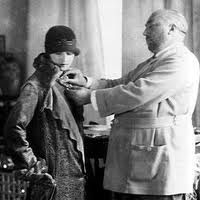
Callot Souers.

Callot dress 1915.
Having looked at the world of Poiret and the French Couture Houses, I think it only fair to include some of his contempories of the time in a few blogging posts this week. Poiret wasn't the only thing going down in "Gay Paree".

Callout Souers - The Callot Sisters - was a Paris fashion House opened in 1895, operated and run by the four Callot sisters. Marie Callot Gerber, Marthe Callot Bertrand, Regina Callot Tennyson-Chantrell and Josephine Callot Crimont. Only the eldest sister Marie was actually trained in dress making but all the sisters had been taught sewing and lacemaking by their mother, herself a lacemaker by profession.
They started their small business by working with antique laces and ribbons, sewing them to lingerie and to enhance blouses. This attention to fine detail was what their work was known for and it led on to expansion in the business, by 1914 their fashion house was on it's way upwards.
As with the whole of Europe at the time the Orientalists movement was cutting a swathe and for the Callot sisters this meant that their work took on an exotic feel by working with gold and silver lame to make their dresses. One of the first designers to do so and they embraced the whole metallic thread theme creating some of the most beautiful intricate dresses I have even laid eyes on. So delicate with tiny detailing, like shimmering mermaids on land. Remember these metal threads and ornamentation were designed to catch the subdued candle light at evening parties and the moons romantic rays. To flicker and dance with light as the lady in question gracefully glided by on the arm of a certain gentleman. It was fairytale magical imagery. Personally I think it is in evening gowns that this fashion house shone and sparkled. These gowns have to be seen to be believed at the amount of work and love that created them.


Short cape.

A Caollot day dress, with just a teeny
bit of gold thread sparkle.
In 1928 Marie Callot Gerber's son, Pierre, took over the business but in 1937, the House of Callot Soeurs closed and was absorbed into the House of Calvet (Marie-Louise Calvet); under the Callot label. When the Second World War erupted it made matters difficult in France and the Callot label finally closed in 1952, but look what a beautiful gift they gave to the world.

Thursday, October 27, 2011

Paul Poiret and his Kimono Coat.

Paul Poiret 1879 - 1944. This
picture was taken in 1913.
At the turn of the 20th Century "Gay Paree" was the place to be. Paris was the epi-centre for the Couture Houses and designers, they became a stopping point for the lesiured classes and Royalty. Among these Couture House's was Paul Poiret. That's Poiret, not Poirot of Agatha Christie's little grey cells fame, n'est pas.
It was Paul Poiret who completely revoultionized the female shilouette and gave us the high waisted empire line dress. C'est magnifique! Poiret was to fashion as Picasso was to art. A head turner, mover and shaker. He was visionary.

Denise Poiret in her husband's iconic
Kimono coat. 1911.
Born in the gritty part Paris, France in 1879 Poiret was born to a cloth merchant family but apprenticed to an umbrella maker. This did not deter him, because still working with the scraps of material from the umbrella's he fashion outfits for his younger sister's dolls, eventually taking his designs and sketches to a pominent dressmaker who instantly bought dozens of his designs. This led him to find employment in one of the Parisian Couture Houses by Jaques Doucet and there a legend was born.  Moving fashion houses as he grew in elevation he designed elegant yet simple practical dresses for the modern woman. However for some his work was abhorrent and too crass, too modern, so in 1903 he set up his own fashion house and designed his innovative masterpiece, the Kimono Coat.
This coat, OMG!! Chic, classy, way out and totally stroke-able beautiful. I must have one!!! I want one, I want one, I WANT ONE!!!!!!
Yet at the time, unbelievably critics didn't love it so much. I know!? But it was soooo new, sooooo in your face different -  that it was shocking. I just think it's beautifully drool-able. What did Poiret do about his critics - well, he threw massive lavish parties and designed flamboyant window designs to bring even more attention to his lavish creations and it worked. Poiret knew his worth in marketing. Infact he was a marketing genius. He had his wife Denise (formerly Boulet) model his Kimono coat for fashion shoots photographed by the celebrated American artist and photographer Edward Steichen- something not commonly done before - his photos of Poiet's designs and gowns were published in the magazine Art et Decoration in 1911 are widely believed to be the first modern fashion photgraphs published. Poriet didn't stop there, he then went on to design a signature perfume, called 'Parfums de Rosine', named after his daughter and he was the first fashion house to do so. When he unveiled a new design or line, he would throw fatastic evening soiree's and extravagant balls making his designs the talk of the fashionable elite. He was a motivational machine in human form.
For Poiret his motivation and muse was his beloved childhood sweetheart and wife Denise, whom he married in 1905 an together they produced five children. Throughout most of his working life Poiret it can be said that he designed with only one woman in mind, his wife Denise.
In 1913 Poiret told Vogue "My wife is the inspiration for all my creations; she is the expression of all my ideals". It seems perplexing then that in 1928 they divorced  in less than amicable circumstances. Madame Poiret kept many of the gowns her former husband designed for her and in 2005 they were bought by the Metroplitan Museum Of Art, in New York.
At the height of his fame Poiret designed clothes for women such as Peggy Guggenheim, Lillie Langtry, Josephine Baker, Isadora Duncan and Elsa Schiaparelli.

Poiret's Hobble skirt. He liked to
boast with this design that 'He freed
the bust but shackled the legs'.
 During the First World War Poiret left Paris and his successful fashion house for the army and streamlining uniforms, when he returned in 1919 his fashion house was already on the brink of bankrupcy, new designers had moved in on his market during his absence, making sleek chic clothes that promised quality craftsmanship. When he met one of these young and upcoming designer's who was to take the 1920's by storm, a miss Coco Chanel, he noted her  wearing one of her classic simple black dresses. He enquired of her "For whom are you in mourning Madmoiselle?" , her reply was "For you Monsieur Poiret".
Poiret's once seemingly simplistic designs were now over worked and fussy. Poiret was out of fashion and business. In 1924 with his designs out of favour and over priced he spoke once more of Ms Chanel "What has she invented? Poverty de luxe". By 1929 Poiret's fashion House had closed with reminent dresses sold by their weight for rags. His decline into embarrassing poverty led him to become a street painter to local street cafes. Later in his life ill with Parkinson's disease Poiret died in 1944 and was forgotten in time. Even his funeral was paid for by an old friend Elsa Schiaparelli, the Italian fashion designer.

Model showing Poiret's draping gowns.
Denise Poiret in Faune ensemble 1919.


Personally even from a twenty first century view point, I find Poiret's designs refreshing and liberating. He was one of the founding designers responsible for freeing woman from their tight laced corsets and restricting boned gowns, then helped introduce the bra. He invited women of the era to brave the streets and even the mobs who booed and hissed at them for their new found body liberation. His Kimono coat is one of the most beautiful coat designs I have ever seen. His other memorable designs given to the world include the notorious Hobble skirt which caused public outcry, Harem pantaloons (of  which recently there has been a big revival in stores), the sack dress, lampshade tunics, la garconne and his draping dress designs. His structual simplicity is the key to his designs and the gateway to leading other modernist designers. Without him where would designs be today? There may not have been the Flapper era, that boyish charm of simple yet bold empowering design. He broke the moulds of tailoring to introduce draping dresses, that "dressed a woman from afar" drawing on Greek influences. He helped bring the Oriental influence into modern Western clothing, making it chic and fashionable for society gals to wear.  In 1911 he founded Artelier Martine, named after yet another daughter. It was a centre of academic fashion where young untrained women and girls were trained to express their own individuality in textile design for furniture and fashion textiles and wallpaper design. This was at a time when women were fighting for the vote in England. He was so ahead of his time. Free without constraints. Everything is an evolution and Poiret is a big marker on the vintage fashion timeline.
Denise Poiret 1913 in New York.


The Kimono Coat.
On my Christmas list this year will be the book Poiret by the Metropolitan Museum Of Art, New York City.
Poiret
Coat 1919.


From the private collection of Denise Poiret - now at the Metropolitan Museum of Art, New York.

Monday, October 24, 2011

Are you a Robe, Gown or Peignoir Girl?

Now the weather has taken on a slight chill I have changed a vital piece of my wardrobe - my dressing gown - from silk to fleece.  This small act started me thinking about the humble dressing gown or robe as some call it. From whence did it originate?
The Medieval female  robe.
Well, according to the word root dictionary, the word robe comes from old English and literally means garment, but it's thought that it originated from the Frankish language (which is an extinct old West Germanic language) from the word 'rouba' . Scholars think this comes from the word 'to rob', meaning of gowns and clothing, because material was very expensive and time consuming to produce in the Middle Ages. Especially if it was of fine quality, it could be worth a lot. This word then has travelled down to our language of today to eventually mean a woman's dress or long wrap, hence the word dressing robe. The distinction of difference being that a robe had long sleeves, as opposed to being a cape or a cloak.

Pattern for 1920's Housecoat.
Over the years there have been many variants on the usage and words associated with robe. There's the dressing robe - which years ago meant a male garment or the dressing gown - a loose garment with a wrap belt worn when one is relaxing about the house usually in bedwear attire.
Then there's the humble bathrobe made of absorbent material to wear after a bath, and the housecoat - worn in the 1930's and becoming very popular in the 1940's. This was not worn for bed or relaxing, but generally about the house as the title suggests. Perhaps it's other commonly referred to name will give you a clue to it's usage, 'the duster' . Longer than an apron, but less coverage than a pinafore, the housecoat was worn to protect the lady of the house's beautiful dresses whilst she bustled about the house doing her daily chores. They were made from a variety of light fabrics and some were even quited for extra warmth. Woman it seems found them so comfy that they started wearing them in longer styles in the evenings for lounging around, making the fashion industry design more stylish numbers. This then is the pre-outfit to our modern dressing gown......but where did it originally originate from in history?
Nicolas Bylston in a green Banyan,
painted 1767.

An aged Sir Issacc Newton in a Banyan,
painted by James Thornhill 1709-12.
It seems that looking back over history the dressing gown or lounge robe, whatever you wish to call it has been with us since the early 17th Century in disguise with a rather peculiar name, the Banyan.
Vintage Male Banyan.
The Banyan originally only worn by men, of course, was a dressing robe - rather like an English Tudor styled nobles robe but with sleeves reaching to the knees and a heady mix from the Persian or Asian style clothes that had begun to influence society. The word Banyan means in Arabic and Portuguese - merchant.
With the Orientalist movement in Art it was only fitting that it moved over into fashion.The exotic oriental style had become the latest fascination for Europe and so the robe took on an exotic matching flavour becoming more flamboyant and resplendent in it's fabrics and colours. It was around this time that it started to become known in our English culture as a morning gown, or robe de chambre - nightgown, becoming a floor length gown and at last it took on the appearance that we feel familiar with today. The range of materials increased to include Indian and Chinese silks and bedtime chic was created in Europe.
Dressing robe for women.
But what of the women? When were we allowed to wear Banyans and nightgowns..........well of course we did but not as extravagant as our male peacocks, that didn't occur until the 18th Century I'm afraid with the introduction of the Japanese Kimono into Western thought.


1920's Kimono styled robe.


1930's Hollywood glamour in black.


Then of course in the 19th Century we had the delectably named Peignoir. What a delightful word, it just simply rolls of the tongue with ease and sophistication and a touch of naughtiness.......peignoir.

1930's robe.

With the Peignoir 'comfort' was the ultimate key word. A woman's comfort in those days was hardly ever thought of in clothing that was so very restrictive in every way shape and form, yet here was a delicate little number that allowed just that.....comfort so women could breathe away from the dreaded laced corset.
Usually made of lace and chiffon, it was light and airy to wear and felt cool against their skin. The word Peignoir comes from the French word 'peigner' to 'comb ones hair' from the Latin pectin/comb. Which is when woman brushed their hair the most - at night. Remember, one hundred stokes girls to make it shiny and lustrous.
Peignoirs were later sold as a whole set of gown, panties and stockings with which to wear to bed. I should think that that appeal alone was enough to men to make the Peignoir an instant hit as the number one saucy Christmas gift of the 19th Century! There is no other era that shows this better than the Hollywood glamour of the 1930's - 1940's with the movie stars and their black and white photography.
The male Banyan developed into the smoking jacket and then sadly both males and female attire seemed to mere into the androgenous terry toweling dressing gown that we see hung on shops rails today. I must say they're jolly comfortable not very glamorous or sexy - what's wrong with a little bit of sexy glamour?! Bring back the peignoir! Of course it's still around and the best places to find them apart from the high street lingerie shops are in the vintage boutiques. Perhaps a peignoir will be on your naughty Christmas list this year? I know it'll be on mine. ;)

Sunday, October 9, 2011

Just a mild vinatge obsession..ever so slightly.....

I am a vintage fashion whore and that includes photography, which I will drool over and stroke lovingly when I find an outfit that I dearly covet. It isn't a pretty sight - it is an addiction - and the only cure is vintage shopping - hours and hours of vintage shopping therapy. I think I am nearing that point of obsession and need a session of retail therapy soon. Good job I have a vintage shopping excursion with a dear friend booked for the end of the month! Which is why I have clothes and lists on my mind so much at the moment. I am busy compiling a list to search for.
Cocopana dancer 1953 - the eyes, the gloves.

The dress.

Dress!

40's bathing costume - glasses.
French Chic.
                                                                   

Chic Fur.

EVERYTHING!
Really, I have thousands of these kinds of pictures on disc - thousands! I am compiling them to cover my bedroom wall in them. YES, REALLY !! Every so often I print ten off ten or so and put them in a box, and then they will be pasted on my bedroom wall - ALL OVER! Floor to ceiling. My OWN wallpaper, my OWN design, my OWN idea. No one will be able to copy - it will be my OWN inspirational sanctuary - espeically in my walk in wardrobe. I can't wait!!!!!

Friday, September 2, 2011

The 18th Century IS back in Fashion !!!!!!

The Palace of Versailles.
How I wish I could be there! Versaille is one of those places on my list of where I want to visit once Mud Boy and I are on our way travelling after our 'home Ed' phase of life is over. 'Travelling' - It's the next phase.
At the moment there is a
1780 - 85 camisole & skirt.
F A N T A S T I C exhibition on at Versaille, in France, once the private Palace of Queen Marie Antoinette. One of the most misunderstood and misrepresented women of history, along with Anne Boleyn, Queen Charlotte and several other women I could list.

Mugler - I want !!!!!!
The exhibition is on from the 8th July to the 9th October and I have very, very little chance of being able to see it. My life here is simply too busy. This is what I have to keep reminding myself lately , we have moved into the next phase. I see life as phases and contained inside those are groups of years, when certain things are very important to you or very predominant. Like those years when you constantly have a buggy, babies, small children, exploration and discovery years - our family has moved on from the early home ed years and even the middle discovery years of home ed - we are now on the last legs of our home ed journey. The next few years of our lives, is only a short phase - It's the exam phase, because no sooner than Diggy and Budge pass through it - Pickle will step into it. That is, if she wants to take any exams or go a different route. As of yet we are unsure and so is she. She's only ten!

1730 court shoes.
Vivienne Westwood.
So this is where we shall be for roughly the next ten years. And not all of that may be exclusively home ed. Of course that doesn't mean we can't have treats, visits and a life! But we can't just swan off, like we used to when the girls were small. Now is the time to buckle down. We have schedules, goals and deadlines to meet. So for now, I shall content myself with looking at the exhibition from afar and console myself that in ten years time or less, they will have an even better exhibition on, of even more restored pieces when it is my turn to visit. Who knows maybe it will be next years family holiday destination!?

But, back to the exhibition. The gowns are exhibits of  works by the marvellous Vivienne Westwood, Karl Lagerfeld pour Chanel, Dior, Jean Paul Gaultier, Christian Lacroix, Olivier Theyskens pour Rochas, Martin Margiela, Azzedine Alaïa, Alexander McQueen pour Givenchy, Yohji Yamamoto, Thierry Mugler… all of them fantasised about the 18th century.
All of them are influenced by this period of fashion. I am entranced by it. I dream about it so often I can feel myself walking in such gowns and lifting the hems to walk up steps.
Make no mistake I will get there one day ...... one day.